Why You Should Share Your Secrets
The compulsion and mechanics of baring our soul, to each other, the universe, and future generations.

Rea
· 15 min read

I was eight years old.
My family and I had just welcomed a new baby brother. And now that he's old enough to fly, we were set to leave Singapore, the country I called home for the past 3 years.
We had said our goodbyes earlier that day — the kind that happens in hallways, where nobody has the right words. I stood behind my mother as she gave my toys to the neighbors. We can't bring these with us, she said.
My best friend, Millie, and I hugged in the stairwell of our apartment building. We knew something enormous was about to end, and managed only the surface of it. There was so much we couldn't know. We didn't even have email back then.
That night, I walked to our favorite playground and wrote a letter in the sand. Not one I could hand her — just words I dug into the same ground where we stood hundreds of times, knowing the morning rain would dissolve any trace. I remember thinking, no one would see this, as I dragged my sneaker through the sand, watching the letters take form. I just wanted to express, sincerely, the goodbye I didn't know how to say.
Even if it was seen only by the night sky.
We Were Here
The impulse to express, to mark our passage, has a long and colorful history. We've all seen them, from a holographic sticker on the crosswalk lamppost to the bright graffiti lining the belly of an overpass. Messages that linger where the author once stood present.
In the aspen forests of Nevada, Idaho, and Colorado, you can hunt for these messages in the trees. Basque shepherds who came to America in the mid-1800s spent months alone on mountain terrain, tending herds with no one to talk to.¹ They carved into the bark — in Basque, Spanish, French, and English. Their hometowns, their politics, their heartbreaks, their poetry. Names, dates, faces. Some carvings are still legible a century later. These are arborglyphs, and what strikes researchers who study them isn't the romanticism of it — it's the breadth. The full spectrum of the human condition, addressed to trees, without the particular promise of one day being found.¹
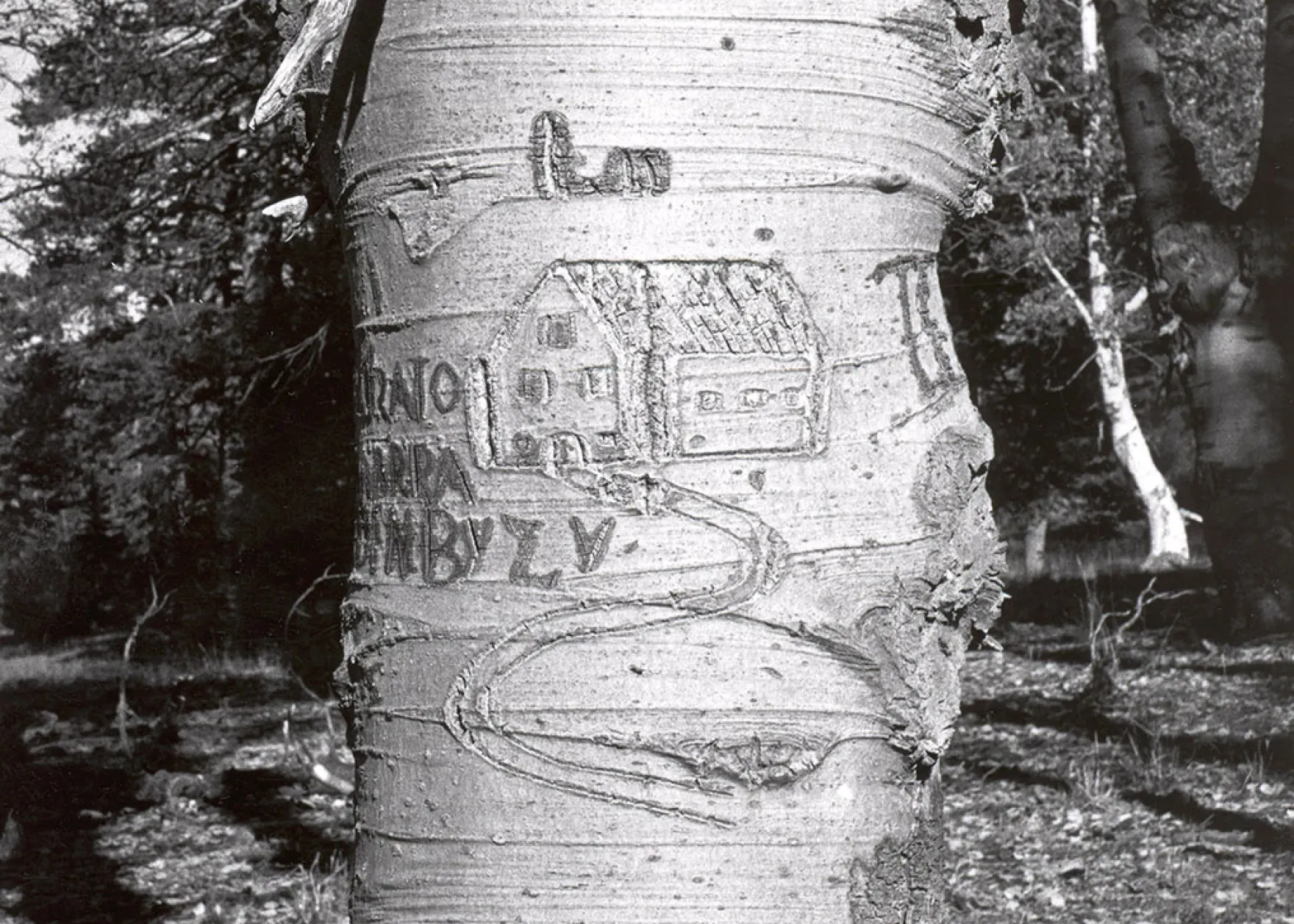
Trees served as writing surface in the forests, just as the concrete jungle has use for walls. Banksy once declared that the wall is "just as good a place to publish" — and graffiti has functioned as public discourse since ancient times, from political commentary scratched into Pompeii's stone to protest stencils at 3am. It is, at its core, an existential act: I exist. I was here. This mattered to me.
Even bridges became the canvas for confession. The padlocks clamped to railings across Europe didn't begin as love stories — though eventually those stories made love locks famous. In Merano, Italy, soldiers completing military conscription marked the end of their service by locking their barracks padlocks to the Ponte Teatro — inscribed with their dates of service.² Cadets graduating from the School of Military Health in Florence did the same at the Ponte Vecchio.² The lock says: I was here. The key thrown into the water says: I won't be back.
By 2015, over a million padlocks — 45 metric tonnes — had been removed from Paris's Pont des Arts after a railing collapsed under the weight.² Folklorist Ceri Houlbrook calls these objects ritual litter: contemporary deposits left on shared surfaces as acts of symbolic meaning.³ The scale alone swallows individual identity — the expression becomes collective. The sheer magnitude of people who keep adding to this collective is now threatening the structural integrity of the bridges — after all, the bridges were not built to be love lock deposits — to the extent that Paris has declared it vandalism.

This is the same urge for expression that Frank Warren collected to a formal address. In 2005, he mailed a hundred postcards to strangers asking them to send back their secrets anonymously. What came back changed his life — and eventually, theirs. Over a million postcards later, PostSecret became the most-visited ad-free blog in the world.
"Secrets can make us feel isolated," Warren wrote, "but sometimes it just takes one person telling their truth to shatter the illusion that we are alone."⁴
Disclosure Begets Disclosure
Sidney Jourard was a humanistic psychologist studying something deceptively ordinary: what happens when people are honest with each other. His conclusion, in The Transparent Self, was striking in its simplicity: "It is through self-disclosure that an individual reveals to himself and to others just exactly who, what, and where he is."⁵
And when one person does this? Disclosure begets disclosure. One person's honesty becomes another person's permission.
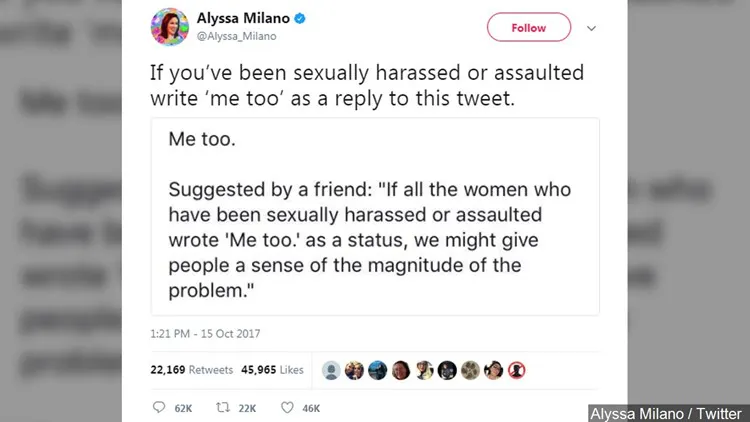
In October 2017, Alyssa Milano tweeted a simple prompt — for the victims of sexual harassment to symbolically raise their hand. Within 24 hours, more than 500,000 people had written "me too" — disclosing experiences they had carried, in many cases, for years.⁶ Research found the movement helped survivors contextualize and define their own experiences for the first time.⁷ One study's title is its own evidence: "I never told anyone until the #MeToo movement."⁸ One disclosure opened a door that millions of people had been standing behind.
But not all disclosure lands the same way, and the form it takes matters. Digital media researchers draw an important distinction between dyadic communication — private, one-to-one — and masspersonal communication, which broadcasts to an entire network at once.⁹ Different social groups are flattened into one audience, in a phenomenon known as context collapse. We begin navigating competing relationships, managing social risk, becoming subject to many judges simultaneously. Researchers call this the "many minds problem."⁹ This can lead to a lack of confidence around what is sharable, anxiety over who has read what, and hesitation to seek disclosure entirely.
However, in one-on-one exchanges, the gap between the socially confident and the socially anxious disappears — both benefit equally from telling the truth to a trusted person.⁹ What this suggests is that meaningful disclosure doesn't require a crowd, or social capital, or skillful delivery. It requires one person with the capacity to receive it.
Talking to someone can't magically solve our problems. But staying silent is reliably worse.
The Cost of Keeping Secrets
Jourard published his study on intimacy and disclosure in 1964:
Concealment... results in sickness, misunderstanding, and alienation of self.⁵
Half a century later, Bessel van der Kolk published a book on trauma survivors:
Secrets breed sickness. Find companions who can tolerate your reality. Shared experience dissolves shame.¹⁰
One was studying healthy people trying to connect. The other was studying people who had survived things most of us can barely imagine. They arrived at the same conclusion: concealment is the disease. Being known is the medicine.
Van der Kolk's research added something specific: the ability to tell a coherent story about a difficult experience predicts recovery.¹⁰ Not the most polished version — just one with enough structure to be told. Where events have sequence, feelings have names, and the person telling it can locate themselves within it. Holding it in privately, indefinitely, has a measurable cost.
The need to share, fortunately, seems quite instinctive, whether we act on it or suppress it. Most of us have probably felt the palpable weight of holding something in, and how it felt to let it out.
The Reflex
Bernard Rimé spent decades documenting something that surprised even him: 88 to 96% of emotional experiences are shared with at least one other person, usually within the same day.¹¹ A staggering statistic on the impulse to confide.
This isn't a finding about extroverts or people who are extra sensitive. It holds across cultures, ages, and personality types. Rimé's argument is that social sharing is not really a decision — it's a pressure that builds until it has somewhere to go. The emotion itself generates the need.
What happens after is easy to overlook. The person we tell can become emotionally activated, and that can create their own need to share. About two-thirds of people who hear a shared emotion go on to share it again.¹¹ The disclosure travels without the discloser. One conversation ripples outward through a network, carried by people who heard it secondhand, so one isolated — and potentially isolating — incident can propagate into collective understanding.
When you share something real, you may unlock something in the listener. Emotions spawned from experiences are alive in that way, weaving from one person to the next. We can see points of convergence, spurred on by modern resharing mechanics, towards the need to express and make meaning. The million padlocks. The 500,000 tweets. The same pressure finding different surfaces. All of it moving.

In today’s world, the term “sharing” is overloaded with retweeting a celebrity clapping back, or sending memes to friends. So we should define what intentional sharing actually means.
The Echo Chamber
Laura Sels and colleagues published a 2024 study following 659 people across their daily lives. They found that sharing an emotional experience was linked to greater emotional precision — but only when the sharer wasn't simultaneously ruminating. When sharing came paired with heavy rumination, it produced the opposite: lower precision, more noise, the loop amplifying rather than breaking.¹²
Rimé also observed that listeners who encourage sense-making and reappraisal produce recovery; those who simply absorb and reflect the distress back amplify the loop.¹¹ The reasoning checks out. When we dwell on an experience, even as we share, we may be soliciting validation for the strength of emotion we feel. And if the listener complies with our fixation on the same emotions, the opportunity for clarifying or reframing eludes us, and we reinforce the same narrative — effectively co-ruminating with the listener.
Emotional precision is not a soft goal. The ability to specifically identify what you're feeling — not just "bad," but whether it's grief or disappointment or shame or loneliness — is strongly associated with fewer symptoms of depression, anxiety, and psychopathology, and with more effective coping under stress.¹³ ¹⁴ Naming what you feel, with specificity, changes how — or whether — you move through it.
Pennebaker's research found a measurable signal for when this is happening: people who benefit most from expressing emotional experiences begin using more causal and insight words over time. "Because" and "I understand" and "I realize." He called this the “completion hypothesis” — putting experience into language imposes narrative structure, transforming what was fragmented into something comprehensible.¹⁵
Written expression appears particularly suited to this: Balon and Rimé (2016) found that written emotional disclosure produces a significantly higher rate of emotion words than oral sharing — more direct, more introspective.¹⁶ It seems that the medium of expression has tangible bearing on the structure of thought. Daniel Kahneman — author of Thinking: Fast and Slow — suggests this framework: our slower system "can construct thoughts in an orderly series of steps."¹⁷ In the same way that meditative practices cannot be rushed, it takes intention to slow the cadence of thought. Pacing our expression creates space for deliberate meaning-making.
PostSecret works partly because of its format — anonymous, one-way, deliberate — conditions for intentionality over validation seeking. Kind Words,¹⁸ the anonymous letter-writing game with over four million exchanges, was built on the same logic: no follower counts, no metrics, nothing that nudges a person toward engagement farming rather than feeling. When the container is designed for care, anonymity amplifies care — because anonymity amplifies whatever norm the space has already set.¹⁹
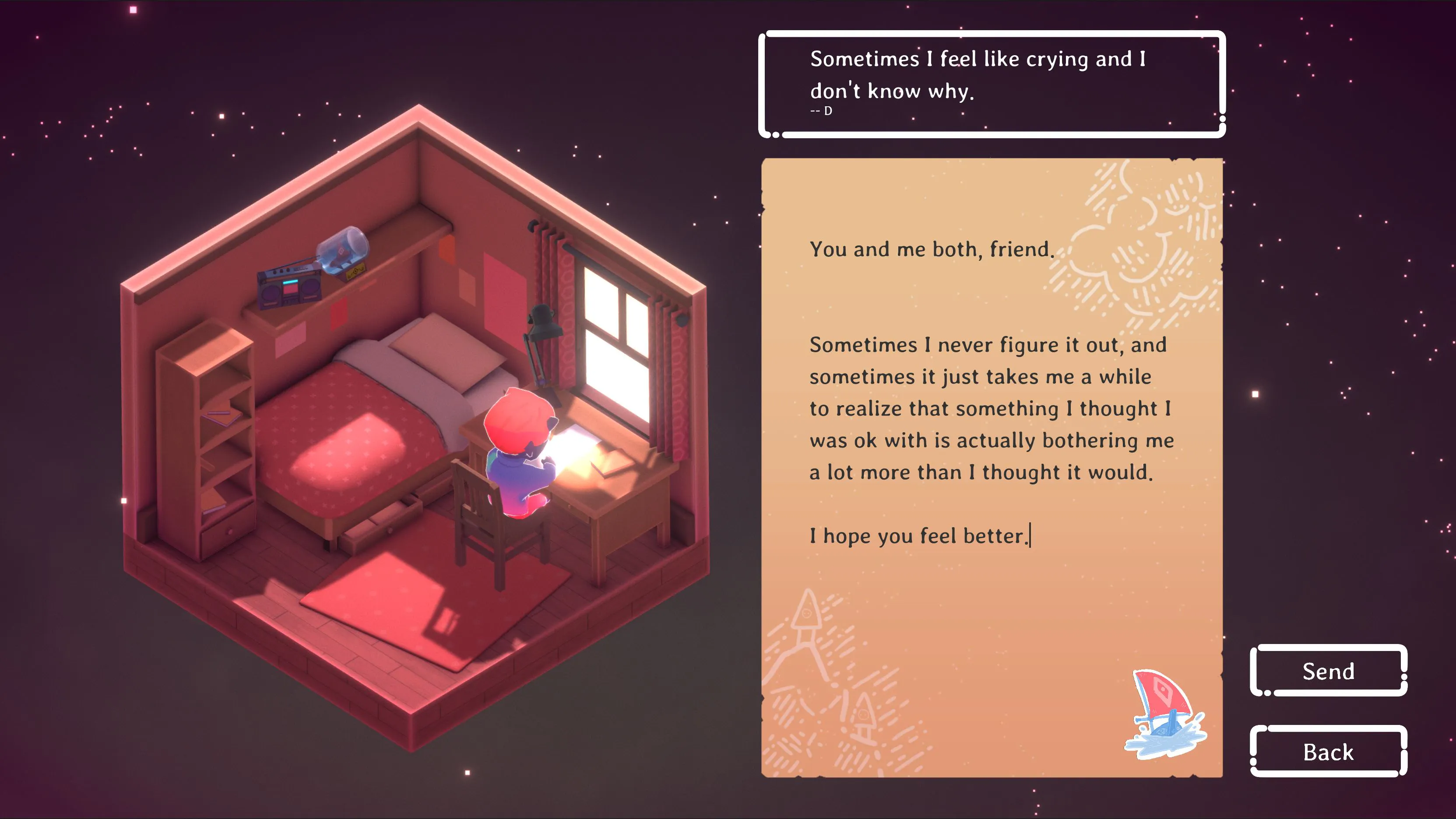
The parallel is striking. Internally, rumination can create an echo chamber of mental loops, leading to a feeling of “stuckness”. Even the act of writing is a step towards sharing what’s inside us, getting us out of our head, and slowing down our barrage of thoughts. The external container — be it a postcard or diary or a cozy game community — if framed intentionally, amplifies understanding and growth.
The Container For Release
One of my most prominent memories of disclosure happened with a stranger in college. In between the long hours I spent on the inconveniently-staggered take-home exams during finals week, I barely had time to visit the cafeteria or sleep through the night. The Caltech Computer Science department in particular had all our deadlines well after midnight, and the other core exams were due at the crack of dawn. I barely saw my friends or other humans when the deadlines drew close.
So imagine my surprise, when one night, around 3 or 4am, I encountered a transfer student in the shared bathrooms. I knew who she was, although we never officially hung out. The always composed, unexpectedly witty, casually cool brunette from down the hall. She was none of those things that day. Her eyes a touch red, not likely from the late hour. I asked, with the caution of respecting all social norms, if she was okay. She shook her head.
"I feel like I don't know what I'm doing. And everyone knows it."
It took a lot of self-control not to blurt out the contrary. "Every time I've seen you, I’ve found you brilliant. You're really inspiring. Transferring here. Overloading on units. Your opinions are hilarious. Everyone knows that. I didn't think you needed to be told that —"
"But I do need to hear that." She whispered.
“Oh…” I nodded. Then hugged her. I remember this moment vividly — it was like someone turned the static down. She cried into my shoulder, softly but heavily, like a breath long held. I absorbed her tears and fears. It didn't make me judge her. I respected her more for it.
We stood there. It must have been only a moment. But I wondered how long she had waited for someone to give her feelings permission to land. Permission to utter a simple human need. And I hoped that freed her of some weight.
This is what van der Kolk means when he writes that shared experience dissolves shame.¹⁰ I was not a therapist, not even a close friend. Just a willing container for the mess.
Maybe it's not all that surprising that the witness we seek doesn't have to be a close friend, but the definition broadens even more, to include the unknown.
What was once used as a scientific measurement method²⁰ or a castaway's only hope,²¹ the message in a bottle became a cultural symbol: a note sealed in glass, cast into uncertainty — carrying hope and longing and the human desire to be heard, released to wherever the current goes.²¹ We send out what we need the universe to know. We don't need to know where it lands.
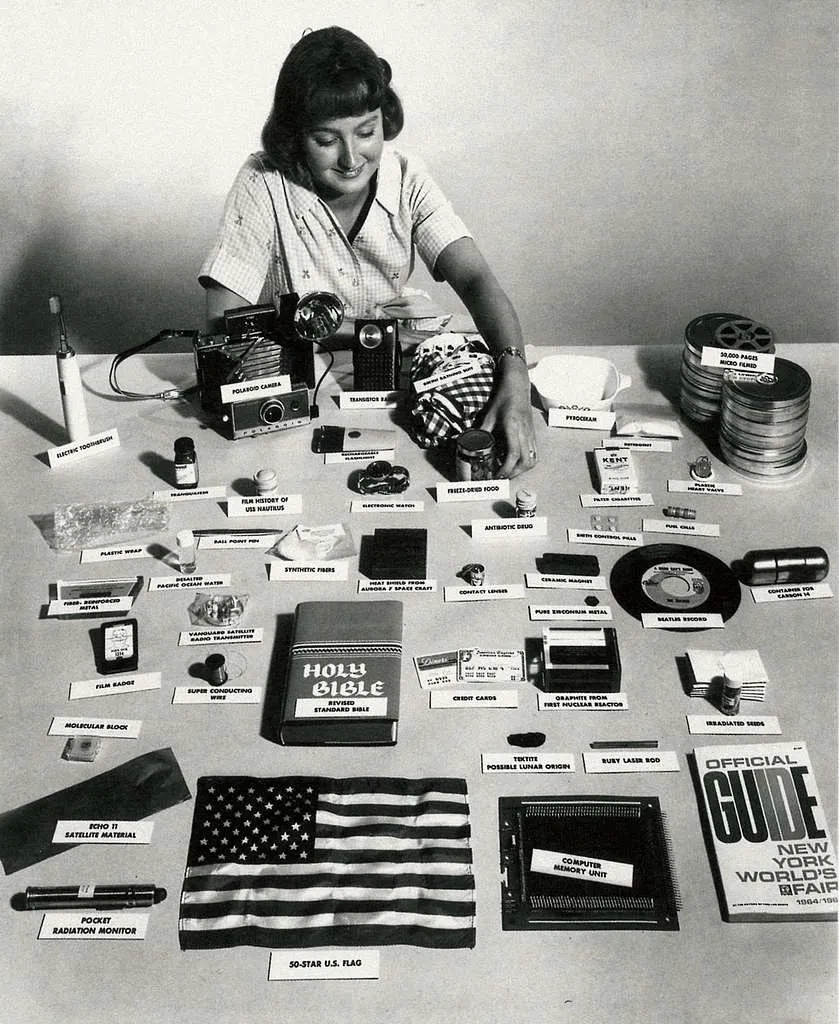
Whereas the message in a bottle symbolizes release into an unknown part of the universe, time capsules are destined for opening at a predetermined time, in the unknowable future. The Crypt of Civilization was sealed in 1940, not to be opened until 8113.²² The Westinghouse Time Capsule — an Einstein letter, a Beatles record, and other ordinary objects of twentieth century living — is scheduled to open in 6939.²³ The people who sealed them knew with certainty they would never see them opened. Psychology describes this impulse as symbolic immortality: the desire to leave a mark that outlasts the passing of time, to send something true across a distance no relationship can bridge.²⁴
On the opposite end of the spectrum, rather than preserving our message for the future, some choose to speak in the present, and only in the present. Skywriting — originally developed as a military smokescreen, eventually repurposed as personal declaration — delivers a message to thousands of onlookers at once, then dissolves within twenty minutes.²⁵ Marriage proposals. Political slogans. A peace symbol traced over Boston Common during the Vietnam War protests. Private sentiment made maximally visible, then given back to the air. The ephemerality is not a limitation. It is the point. Snapchat built a platform on exactly this premise: messages disappear after being viewed.
The research confirms the effect — the ephemeral design removes inhibition, enabling users to share more personal, less curated content than they would on permanent platforms.²⁶ Some truths are only speakable when we know they aren’t forever.
That's All She Wrote
When I got on the plane from Singapore to Los Angeles with my family, it was raining. I imagined my words in the sand, slowly becoming level with the steady tap of raindrops. It didn't make me sad to think of my message erased. The rain was always going to come. And I got to say goodbye to my friend and my home, in the way that I wanted. I felt lighter, as we lifted off, and watched my previous life grow smaller, and smaller. And then there was only blue.
I didn't understand it at the time, but I had made my grief legible. In my memory, the actual in-person farewell with my best friend gets harder to summon, blurred like an aged photograph. I know it happened, but can’t relive it the same way I can the feeling of grains of sand slipping past my shoe.
Jourard would say that's how we come to know ourselves.⁵ Rimé would say the pressure to put it somewhere was built into the emotion from the start.¹¹ Van der Kolk would say that when we finally let it land, something in us heals.¹⁰
From letters in the sand, to writing in the clouds, we seek — we need — to be known.
To this day, many trees still wear our hearts on their sleeves.
• • •
P.S. It occurred to me, that I hadn’t told the story of my letter to Millie until composing this essay. It seemed only apt, that I share an important moment of my life, when urging you to do the same. So — thank you for letting me share.
Sources
¹ Mallea-Olaetxe, J. Speaking Through the Aspens. University of Nevada Press. / Bieter, J. & Oestreicher (2024). https://www.boisestate.edu/news/2024/06/20/bieter-and-oestreicher-publish-article-on-basque-arborglyphs / USDA Forest Service. https://www.fs.usda.gov/wildflowers/beauty/aspen/carvings.shtml
² Houlbrook, C. (2021). Unlocking the Love-Lock. Berghahn Books. https://www.berghahnbooks.com/blog/history-of-the-love-lock
³ Houlbrook, C. (2022). 'Ritual Litter' Redressed. Cambridge University Press. https://www.cambridge.org/core/books/ritual-litter-redressed/7A44706377386D84239985A2A2DD8D24
⁴ Warren, F. PostSecret. Washington Post (2014). https://www.washingtonpost.com/entertainment/books/anonymous-confessions-in-a-tell-all-age-frank-warrens-the-world-of-postsecret/2014/12/09/e627fc76-7988-11e4-b821-503cc7efed9e_story.html
⁵ Jourard, S. M. (1964). The Transparent Self. Van Nostrand. https://archive.org/details/selfdisclosureex00jourrich
⁶ Frontiers in Public Health (2023). Who posted #MeToo, why, and what happened. https://pmc.ncbi.nlm.nih.gov/articles/PMC10025476/
⁷ PMC (2024). Online Social Reactions to Disclosure via #MeToo. https://pmc.ncbi.nlm.nih.gov/articles/PMC10822142/
⁸ Child Abuse & Neglect (2019). "I never told anyone until the #MeToo movement." https://www.sciencedirect.com/science/article/abs/pii/S0145213419304880
⁹ Desjarlais, M. (2022). The socially poor get richer, the rich get poorer. Cyberpsychology. https://cyberpsychology.eu/article/view/14059 / Cooney, G. et al. (2020). The many minds problem, cited within.
¹⁰ Van der Kolk, B. (2014). The Body Keeps the Score. Viking.
¹¹ Rimé, B. (2009). Emotion Elicits the Social Sharing of Emotion: Theory and Empirical Review. Emotion Review. https://journals.sagepub.com/doi/10.1177/1754073908097189
¹² Sels, L. et al. (2024). The Double-Edged Sword of Social Sharing. Psychological Science. https://journals.sagepub.com/doi/abs/10.1177/09567976241266513
¹³ Thompson, R. J. (2021). Gaining clarity about emotion differentiation. Social and Personality Psychology Compass. https://compass.onlinelibrary.wiley.com/doi/10.1111/spc3.12584
¹⁴ Frontiers in Psychology (2021). Emotion Differentiation and Youth Mental Health. https://www.frontiersin.org/journals/psychology/articles/10.3389/fpsyg.2021.700298/full
¹⁵ Frattaroli, J. (2006). Experimental Disclosure and Its Moderators: A Meta-Analysis. Psychological Bulletin. https://bpb-us-e2.wpmucdn.com/faculty.sites.uci.edu/dist/c/602/files/2019/08/Frattaroli-psych-bulletin-2006.pdf
¹⁶ Balon, S. & Rimé, B. (2016). Lexical Profile of Emotional Disclosure in Socially Shared Versus Written Narratives. Journal of Language and Social Psychology, 35(4). https://journals.sagepub.com/doi/10.1177/0261927X15603425
¹⁷ Kahneman, D. (2011). Thinking, Fast and Slow. Farrar, Straus and Giroux.
¹⁸ Scott, Z. (Popcannibal). Kind Words. Kotaku (2019): https://kotaku.com/kind-words-a-game-about-sending-nice-letters-to-strang-1840537946 / Inverse: https://www.inverse.com/gaming/kind-words-2-ziba-scott-interview
¹⁹ Spears, R., & Lea, M. (1994). Panacea or panopticon? Communication Research, 21, 427–459. https://www.semanticscholar.org/paper/A-Social-Identity-Model-of-Deindividuation-Reicher-Spears/f9b95729e84ae2de9a7877dcbf6c861e2576693d
²⁰ Franklin and the Gulf Stream. Smithsonian Magazine. https://www.smithsonianmag.com/smart-news/benjamin-franklin-was-first-chart-gulf-stream-180963066/
²¹ NOAA Ocean Service. https://oceanservice.noaa.gov/news/apr14/message-in-bottle.html / Smithsonian Magazine. https://www.smithsonianmag.com/science-nature/message-in-a-bottle-76039401/
²² Crypt of Civilization. Oglethorpe University. https://oglethorpe.edu/about/history/crypt/
²³ Westinghouse Time Capsule. Heinz History Center. https://www.heinzhistorycenter.org/blog/detre-library-archives-westinghouse-time-capsule/ / Library of Congress. https://blogs.loc.gov/inside_adams/2023/07/time-capsule/
²⁴ Legacy motivations & the psychology of intergenerational decisions (2018). Current Opinion in Psychology. https://www.sciencedirect.com/article/abs/pii/S2352250X18300526
²⁵ Tandfonline (2025). Skywriting as artificial wonder. https://www.tandfonline.com / HistoryNet. The History of Skywriting. https://www.historynet.com/skywriting/
²⁶ Piwek, L. & Joinson, A. (2016). "What do they snapchat about?" Computers in Human Behavior, 54, 358–367. https://www.sciencedirect.com/science/article/pii/S0747563215302132
About the Author
Hi! I'm Rea. I write, draw, and code out of my studio in LA. I research and ponder wellness, expression, and the science of belonging.


