Keeping the Record Straight: The Case for an Archive of Everyday Voices
For most of history, only a fraction of voices were recorded — and even fewer survived. Today, we save everything. But does it lead to truth, visibility, or connection?

Rea
· 17 min read

In spring it is the dawn that is most beautiful. As the light creeps over the hills, their outlines are dyed a faint red and wisps of purplish cloud trail over them.¹
The author was Sei Shōnagon, a lady-in-waiting at the Japanese imperial court around 1002 AD. The entry belongs to a collection known as The Pillow Book — a thousand-year-old bedside notebook of observations, lists, and opinions from the Heian court.
Court-commissioned histories of Sei's period exist, and they record what the period officially remembered: imperial succession, poetic competition, ceremonial rites. The Pillow Book records something else — the musings of an ordinary week. What made the heart beat faster. What was awkward. What the weather was doing while a conversation unspooled. For modern scholars it is now a primary source for the Heian court's sensory life, its manners, and its unspoken thoughts.²
When we leaf through its pages today, we may not question the survival of a thousand-year-old book. It is the collaborative effort of institutions, scholars, translators, and custodians across generations. And yet for every Pillow Book that survives, there are untold numbers of accounts that did not — observations from lives as particular as hers, never to be discovered.
How were the historical archives preserved? What do we gain from the ones that survive? And what shifts when the cost of storing everyone's story drops to nearly nothing?
How Archives Are Kept, Lost, and Saved
The Library of Alexandria, founded in the early third century BCE under the Ptolemaic dynasty, represented the most ambitious scholarly project of the ancient world. Its mission was to gather every book in existence — every play, medical treatise, astronomical table, mathematical proof, and religious text — and house them in a single institution where scholars from across the Mediterranean could work.³

The Library's decline is commonly attributed to a single fire, and indeed Julius Caesar's siege in 48 BCE caused significant damage, with further destruction continuing through the Roman and early Christian periods. But the gradual hollowing began earlier. In 145 BCE, Ptolemy VIII, in political revenge against the Alexandrian elite, expelled foreign scholars from the city and replaced the head librarian — a position previously held by figures such as Eratosthenes and Aristophanes of Byzantium — with Cydas, a palace guard with no scholarly background.⁴ The pattern continued. Over subsequent decades, Ptolemaic and later Roman appointments increasingly prioritized political loyalty over scholarly judgment. The institution did not collapse. It was slowly emptied of the people capable of maintaining it.
A hollowed-out institution accumulates its losses invisibly, year over year, and the damage is often only visible once it is already finished.
The Summer Palace. Eighteen centuries later, a different story with the same ending. During the Second Opium War, British and French forces looted and burned the Yuanmingyuan — the Old Summer Palace outside Beijing. The complex had accumulated centuries of art, manuscripts, imperial records, silks, porcelain, and garden architecture. The burning lasted three days⁵—destruction of a complex covering more than 850 acres. Over 95 percent of the structures were intricate wood-frame architecture, reduced entirely; what was stone became ruins. Portable objects had been looted in the days prior, and many survive in European museums today. But the irrecoverable losses exist now only in descriptions and in the Forty Scenes paintings by Shen Yuan and Tangdai, held at the Bibliothèque nationale de France.⁶

British Captain Butler had sought Victor Hugo's endorsement of the campaign in November of 1861. Hugo, exiled in Guernsey, wrote a now-famous response.
There was, in a corner of the world, a wonder of the world; this wonder was called the Summer Palace... The slow work of generations had been necessary to create it... If people did not see it they imagined it. It was a kind of tremendous unknown masterpiece… This wonder has disappeared.⁷
The Summer Palace illustrates the vulnerability of a centralized archive: concentration makes preservation more efficient and the wealth of knowledge more accessible, but it also makes destruction effective and complete.
The Manuscripts of Timbuktu. For generations, Malian families in Timbuktu maintained private manuscript collections — Islamic scholarship, astronomy, medicine, poetry, law — passed down across centuries. In 2012, as armed extremist forces advanced through northern Mali, the custodian Abdel Kader Haidara, working with the local organization SAVAMA-DCI and an extended network of family collectors, coordinated the evacuation of approximately 350,000 manuscripts. They were packed in metal trunks, moved in small batches by donkey cart, and transported by boat down the Niger River to Bamako.⁸ The Hill Museum & Manuscript Library has since digitized approximately 308,000 of them, producing roughly 4.35 million image files. Cataloging continues today, at the time of writing.⁹
Not everything could be moved. Some manuscripts were too fragile to survive handling. Others were housed in public institutions rather than family collections — most notably the Ahmed Baba Institute, where approximately 4,200 manuscripts were burned or stolen when militants retreated in January 2013. Earlier losses, spread across generations, are harder to count: some manuscripts were lost to climate, termites, and neglect before coordinated preservation took hold.¹⁰

These events, and the many more before, between, and since, show that the preservation of any artifact was a monumental feat, compounded by its age. Whether the knowledge of civilizations and past generations was eroded through neglect, decimated through calamity, or rescued through coordinated effort, the calculus is similar. Some survive. Others do not. And beyond what institutions hold, there are the stories that never made it to any archive — the memories that faded with the people who carried them. The archive that survives is a marginal fraction of the stories that existed.
Are These Dusty Tomes Worth the Effort?
Given the endeavor to keep the records safe and the fragility of the structures that once held them, it's valid to question the actual benefit we gain.
The Partition Archive. In 1947, the partition of British India produced one of the largest forced migrations in human history — approximately 10 to 20 million people displaced, with significant violence across the newly drawn borders.¹¹ For decades, the historical record centered on political negotiations, national narratives, and aggregate figures.
In 2009, the historian Guneeta Singh Bhalla began recording oral histories of survivors. The project became The 1947 Partition Archive, now headquartered at UC Berkeley, and has collected more than 12,000 testimonies from survivors worldwide, as of writing.¹² What the testimonies contribute is not primarily the scale of the event, which was already known, but the essence of ordinary life that preceded and followed it — the layout of a courtyard, the neighbors' names, the smell of a particular season, the songs sung on a train. These are the details that make history recognizable as lived experience rather than policy.
The oral histories provided new perspective: inter-communal violence was not universal — many testimonies describe neighbors of different religions actively protecting one another during the migrations, counter to the dominant national narratives on both sides of the border. Women's experiences, including sexual violence, abduction, and forced conversion, were systematically under-represented in official histories and are recoverable almost exclusively through oral record. The emotional weight of Partition was often carried in the absences — songs no longer sung, recipes no longer shared, languages no longer spoken at home.¹³ These are not supplementary details. They reshape what Partition is understood to have been.

Although the work is necessary, it is an exercise in catching up. By 2009, many witnesses had passed away, and memory across six decades softens and rearranges. What remains is a recovered fragment of a much larger record, not feasible to collect as it happened.
USC Shoah Foundation. A more systematic effort, on a larger scale. Founded in 1994 by Steven Spielberg after the production of Schindler's List, the USC Shoah Foundation has collected more than 55,000 audiovisual testimonies in 44 languages from 70 countries, as of writing.¹⁴ The methodology is specific: audiovisual interviews conducted over several hours, covering life before, during, and after the events; indexed at the minute level; searchable by theme and keyword; distributed across multiple institutional repositories for redundancy.
The archive is built not only for present-day understanding. It is structured to be usable by future researchers who do not yet know what questions they will ask. That foresight is itself unusual — most historical archives are assembled with a present purpose in mind and adapt, imperfectly, to new questions as they arise.
Lessons from Genocide. One example of what becomes possible at that scale: In 2024, Johanna Ray Vollhardt and colleagues published a study in the European Journal of Social Psychology that drew on the Shoah Foundation's collection and comparable testimony archives, analyzing 200 survivor testimonies across three atrocities: the Holocaust, the Rwandan genocide, and the Nanjing massacre.¹⁵ Distinct categories of lessons emerged across cultures.
One of the primary sentiments was the desire to be remembered. Never forget appeared with the same frequency and urgency as the desire to prevent recurrence — never again. Survivors did not treat being witnessed as secondary. They treated it as necessary in its own right.

Testimonies do not only reflect individual experience. They shape collective memory and transmit moral frameworks. The narrative a community carries forward can move toward division (protect our own) or toward shared responsibility (this happened to us; it can happen to someone else tomorrow).
The surprising fact was that every group carried evidence of all lesson categories, despite differences in culture, language, era, and individual circumstance. No matter how the data was sliced — by time period, by gender, by geographic origin — the shape of what survivors drew from catastrophe was broadly similar across the three cases.
The authors themselves note the limitations of the study: only 200 testimonies met their criteria, across three events. A significant sample but not a comprehensive one. An even larger number of records across a wider range of events would strengthen and refine the findings. Archives make research possible that would otherwise be too methodologically fragile, or too logistically expensive, to attempt.
Pandemic Journaling Project. The Pandemic Journaling Project, co-led by the University of Connecticut and Brown University between 2020 and 2022, collected over 27,000 journal entries from more than 1,800 participants across 55 countries.¹⁶ Its structure is significant: decentralized, democratic, open to anyone with an internet connection. Contributors retained ownership. No editorial curation determined whose account was worth keeping.
It also demonstrated something historically unusual: real-time shared witnessing, across borders. People could read each other's entries while living the same global event — not decades later through a study, but as it unfolded. A living archive enables something historical archives cannot, allowing experiences to resonate and reassure from the moment of recording.
Pieve Santo Stefano. Where the previous archives respond to crisis, a small Tuscan town takes up a proactive mantle. Since 1984, the Archivio Diaristico Nazionale has served as the official Italian repository for ordinary diaries, journals, and letter exchanges.¹⁷ Any Italian can submit a personal text — a diary kept during a war, a grandmother's letters, a schoolchild's notebook. A volunteer jury reads submissions each year and selects finalists, who receive a small literary prize and whose work is preserved in the archive. Thousands of manuscripts are now held there — soldiers, housewives, schoolchildren, road workers, small-town shopkeepers.
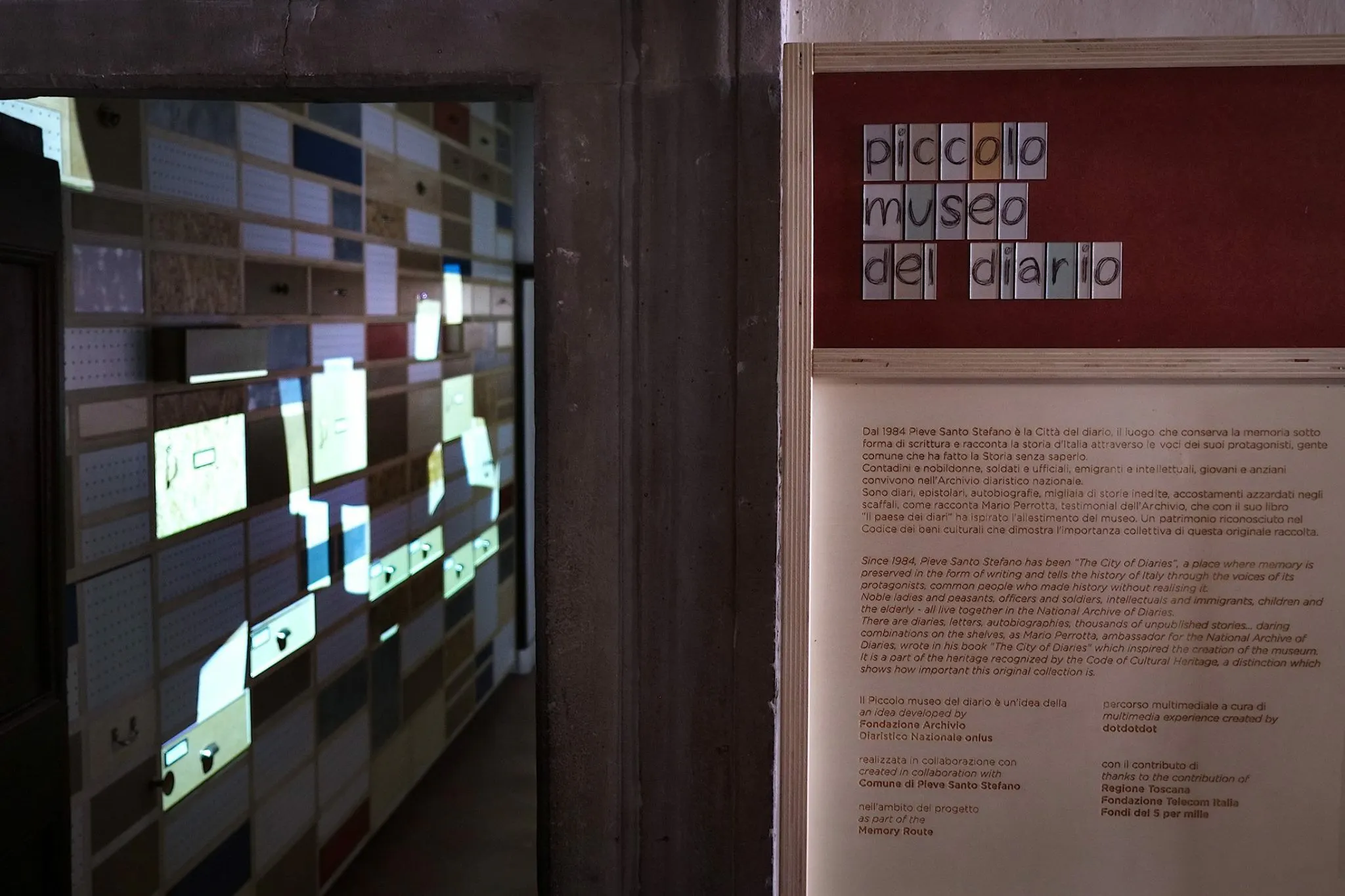
The archive's value is not sentimental, but structural. Domestic life in twentieth-century Italy, thoughts from ordinary people about new legislature, the private sentiment of public events.
Capturing only the crisis is like a story that tells the climactic twist without the chapters around it — the pivotal moment survives, but the weight of the surrounding context does not. Human experience is a continuum, not a series of bursts.
A widespread archive gives us a foundation for future curiosity. A real-time archive breeds resonance and bonds communities. An ongoing archive weaves the backdrop on which to understand any narrative, instead of existing to fill the gaps. To fulfill all three would be unprecedented.
In the Digital Age, the cost to achieve this lowers dramatically. But with that evolution comes new complexities.
Challenges of Modern Archives
Digital preservation changed the equation substantially. Disaster and wartime destruction cannot as easily expunge libraries. The manuscripts of Timbuktu are digitized. Shoah Foundation testimonies are indexed and searchable. Pandemic Journaling Project contributions are archived indefinitely at negligible cost per record.
But digital repositories are faced with a different dilemma. A significant portion of the media that shapes public understanding is now controlled by the platforms that distribute it. Algorithmic curation — not editorial judgment, not scholarly review — optimizes for engagement. What rises in visibility is not necessarily what's accurate. It's just what keeps users scrolling.
The Philippines 2022 election offers a well-documented case study. In 1972, President Ferdinand Marcos declared martial law across the nation. The period that followed included documented political imprisonments, killings, and the concentration of wealth in the Marcos family, detailed by the Presidential Commission on Good Government established after the regime's fall in 1986.¹⁸ The restoration of the historical record became a decades-long scholarly and civil project.

In 2022, Ferdinand Marcos Jr. was elected president. His campaign drew significant support from a coordinated digital operation. Peer-reviewed research by Jonathan Corpus Ong and Jason Vincent Cabañes, together with documentation by Rappler and VERA Files, shows that historically revisionist content — content characterizing the Marcos era as a period of prosperity, minimizing or denying documented abuses, or reframing survivor accounts — reached substantially larger audiences on Facebook, TikTok, and YouTube than corrective fact-checks and historical scholarship during the campaign cycle.¹⁹
The record existed. The distribution of attention was the problem. A well-produced video and a survivor's testimony did not occupy equivalent space in the algorithm; the better-optimized content traveled further.
The storage was equal opportunity, but the display was not free from bias. Despite those shortcomings, what today's social networks enable is the potential for human connection at a scale never before imaginable.
The Connective Tissue of Human Experience
Before Vesuvius buried the city of Pompeii in 79 AD, its residents scratched things into walls. Prices. Political endorsements. Romantic declarations. Insults. Mathematical calculations worked out in plaster. One catalogued inscription can be translated to:
We have wet the bed, host. I confess we have done wrong. If you want to know why, there was no chamber pot.²⁰
The levity of the confession-complaint is tangible even today. The Pompeii graffiti is studied as one of the more reliable documents of daily Roman life, precisely because it's not a historical account of significance in the conventional sense — no battle, no consul, no disaster.²¹ The humanness it holds — the swallowed frustration, the shy affection, the banter of an afternoon — is recognizable across twenty centuries.
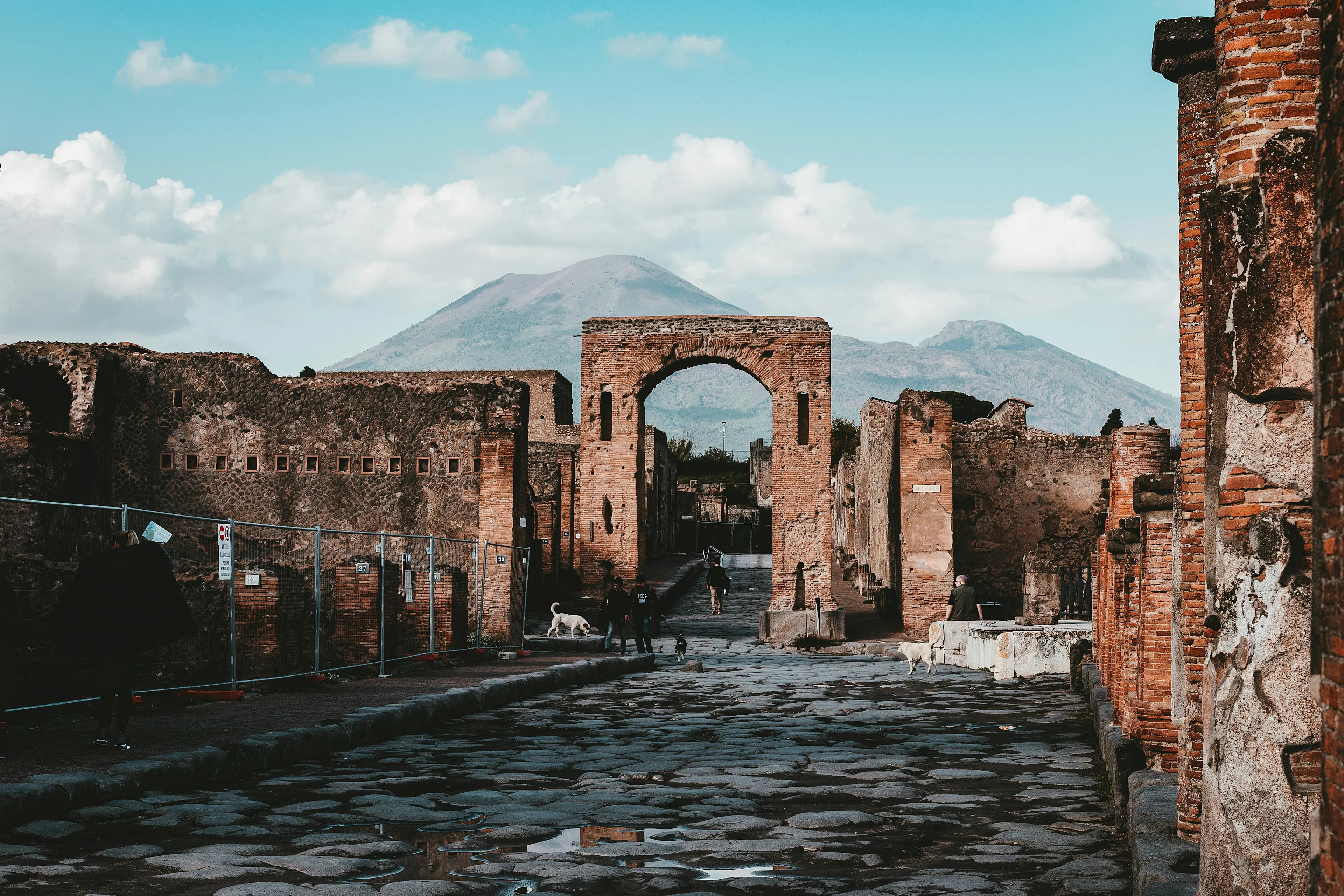
Similarly, the writings below have been preserved across centuries and continents. Each carries the particular voice of its author — but also feels similar in what's familiar.
Few things give me so much pleasure as reading the Personal Narrative; I know not the reason why a thought which has passed through the mind, when we see it embodied in words, immediately assumes a more substantial & true air — In the same manner as when we meet in dramatic writings a character which we have known in life, it never fails to give pleasure.
— Charles Darwin, naturalist. Beagle Diary, 26 May 1832.²²
The hours pass quickly during the day, but the evening brings sadness… The affection, the warmth, the love that only those who truly love can give, and within these cold and monotonous walls of an unknown country, I feel truly sad… Who knows how many poor boys have died and will die up at the front, how many sons have been left fatherless, how many wives without husbands, how many mothers without children. Now they will cry over an image, remembering a body lying helpless in the mud, in the intense cold and unbearable heat, and no one will ever give those people their loved ones back.
— Rossella Canaccini, singer. Pieve Santo Stefano Diary Archive, Saigon 1968.²³
It happened that this was my birthday — and we spent it lying in our bags without a roof or a meal, wishing the wind would drop, while the snow drifted over us… the three of us lay listening to the flap of the ragged ends of canvas over our heads, which sounded like a volley of pistol shots going on for hour after hour.
— Edward Wilson, explorer. Scott's Last Expedition, 1911.²⁴
How ever did I pass the time before I knew you? I think of that past time as now I pass each passing day in lonely sorrow, lacking you.
— Sei Shōnagon, courtier. The Pillow Book, c. 1002.¹
I live in constant desolation, and I don't know what I will become and how I will bear the task that remains. At times, it seems to me that my pain is wearing off, but immediately it is reborn, tenacious and powerful. I want to tell you that I no longer love the sun or the flowers. The sight of them makes me suffer. I feel better on dark days like the day of your death, and if I have not learned to hate fine weather it is because my children have need of it.
— Marie Curie, physicist. Mourning journal, 14 May 1906.²⁵
I have… a great yearning to write all my anxiety entirely out of me, write it into the depths of the paper just as it comes out of the depths of me, or write it down in such a way that I could draw what I had written into me completely. This is no artistic yearning.
— Franz Kafka, novelist. Diaries, 8 December 1911.²⁶
There is no greater agony than bearing an untold story inside you.
— Zora Neale Hurston, writer and anthropologist. Dust Tracks on a Road, 1942.²⁷
Naturalist, singer, explorer, courtier, physicist, novelist, and anthropologist. Spanning centuries, languages, and every register from wonder to grief. Yet the observations themselves are not difficult to recognize. We may have walked different paths. But we easily imagine walking alongside them. Sharing stories that transcend language barriers.
One of the oldest stories illustrates the impact of this connection. The famed builders of the Tower of Babel were punished with the dissolution of their shared language. That single change caused division among the builders, and the differences made cooperation — let alone harmony — impossible. The structure fell not from external force, but from the loss of a common frequency.²⁸
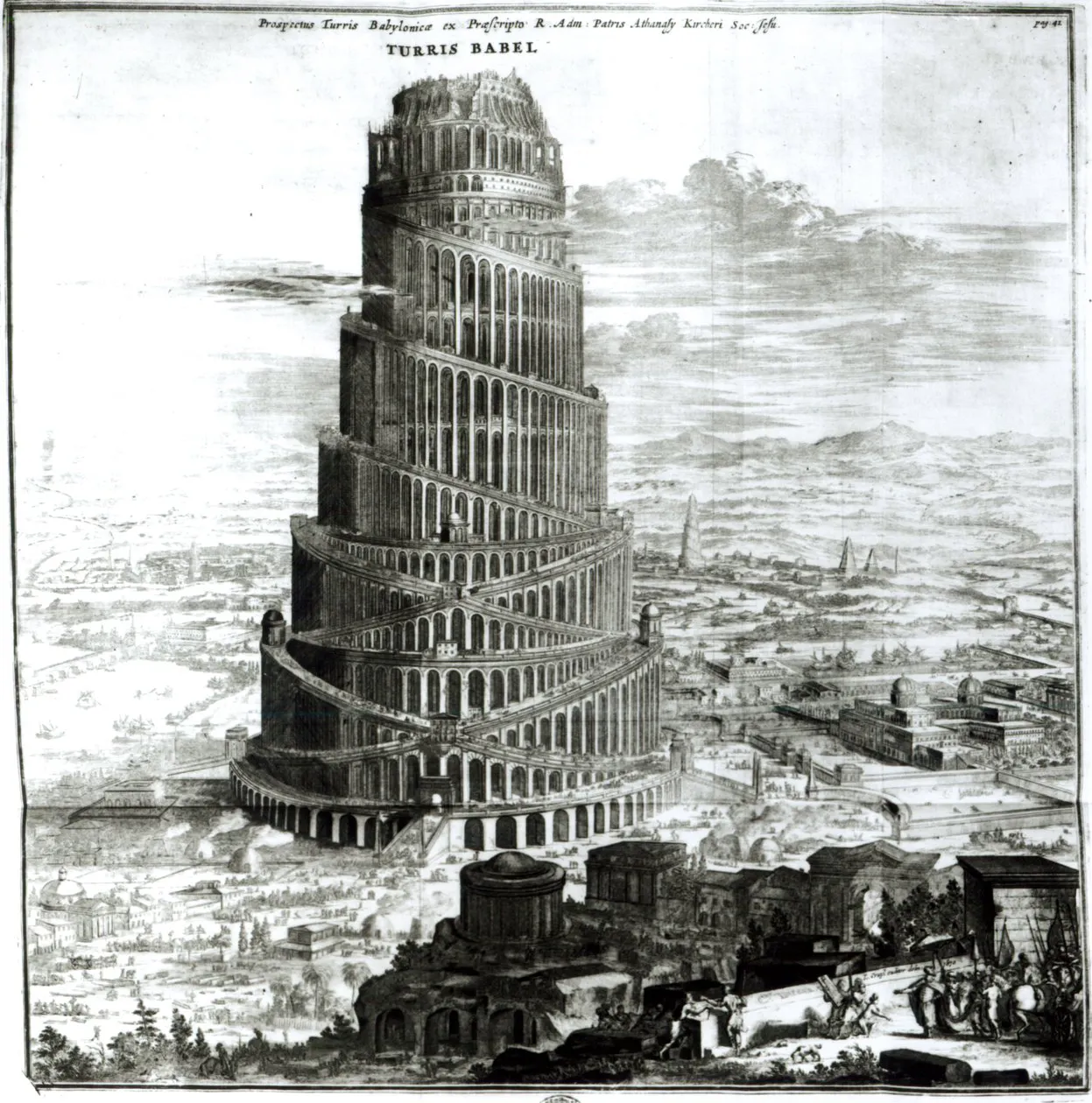
Building a shared language out of relatable human experience is a similarly ambitious undertaking. Trillions upon trillions of stories exist. But now, rather than excavating them from the ashes of Vesuvius, we may need to dredge them from the inundation of modern media, to distinguish the sensational from the sincere.
The Everyday Voice
The evolution of record keeping has seen periods of neglect and destruction, rescue and collection, open-submission and mission-driven, centralized and digitally distributed. Whether to preserve a collection for future researchers or to enable a shared understanding, the calling to record what we saw, what we felt, our very existence — stayed strong.
In the modern age, we sit in the unique position to afford anyone the means to contribute. As storage continues to become more cost efficient, the emerging challenge is encouraging authenticity in an era of competitive social metrics.
But as the record shows, the complete and inclusive narrative requires valuing every voice. An archive does not choose a single story to save. History is most honest when it represents the times as they were, in its full spectrum of colors and moods and mundane musings. Because the experience of being human is the universal language.
Everyone speaks this language. But each voice says something new.
I have my opinions, my own ideas and principles… I feel quite independent of anyone.
— Anne Frank, diarist. 17 March 1944.²⁹
Citations
- Sei Shōnagon, The Pillow Book, trans. Ivan Morris (New York: Columbia University Press, 1991).
- Donald Keene, Seeds in the Heart: Japanese Literature from Earliest Times to the Late Sixteenth Century (New York: Columbia University Press, 1993).
- P. M. Fraser, Ptolemaic Alexandria, Vol. I (Oxford: Oxford University Press, 1972).
- Fraser, Ptolemaic Alexandria; Roy MacLeod, ed., The Library of Alexandria (London: I. B. Tauris, 2000); Athenaeus, Deipnosophistae, cited in MacLeod.
- James L. Hevia, English Lessons: The Pedagogy of Imperialism in Nineteenth-Century China (Durham, NC: Duke University Press, 2003); Young-tsu Wong, A Paradise Lost: The Imperial Garden Yuanming Yuan (Honolulu: University of Hawai'i Press, 2001).
- Wong, A Paradise Lost; Hevia, English Lessons.
- Victor Hugo, letter to Captain Butler, 25 November 1861. Published in Actes et paroles II (Paris, 1875).
- Joshua Hammer, The Bad-Ass Librarians of Timbuktu (New York: Simon & Schuster, 2016).
- Hill Museum & Manuscript Library, public digitization statistics, 2022–2024.
- Hammer, Bad-Ass Librarians; UNESCO reports on Timbuktu manuscript damage, 2013–2015.
- Ian Talbot and Gurharpal Singh, The Partition of India (Cambridge: Cambridge University Press, 2009).
- The 1947 Partition Archive, UC Berkeley; Guneeta Singh Bhalla, institutional statements and interviews, 2009–present. Collection statistics as of 2024.
- Urvashi Butalia, The Other Side of Silence (Durham, NC: Duke University Press, 2000); Yasmin Khan, The Great Partition (New Haven: Yale University Press, 2007); The 1947 Partition Archive oral history corpus.
- USC Shoah Foundation Institute for Visual History and Education, collection statistics as of writing.
- Johanna Ray Vollhardt et al., "Lessons from Genocide," European Journal of Social Psychology, Vol. 54, Issue 7 (2024), pp. 1577–1592.
- Sarah S. Willen (University of Connecticut) and Katherine A. Mason (Brown University), co-founders, Pandemic Journaling Project, 2020–2022.
- Archivio Diaristico Nazionale, Pieve Santo Stefano; founded 1984 by Saverio Tutino.
- Presidential Commission on Good Government (PCGG), Republic of the Philippines, reports 1986–present.
- Jonathan Corpus Ong and Jason Vincent A. Cabañes, Architects of Networked Disinformation (Leeds: University of Leeds, 2018); Nicole Curato, Democracy in a Time of Misery (Oxford: Oxford University Press, 2023); Rappler and VERA Files fact-check archives, 2021–2022.
- Corpus Inscriptionum Latinarum (CIL), Vol. IV, no. 4957. See also Antonio Varone, Erotica Pompeiana, trans. Ria P. Berg (Rome: «L'Erma» di Bretschneider, 2002).
- Alison E. Cooley, Pompeii: A Sourcebook (London: Routledge, 2014).
- Charles Darwin, Beagle Diary, entry for 26 May 1832. Published in Richard Darwin Keynes, ed., Charles Darwin's Beagle Diary (Cambridge: Cambridge University Press, 1988).
- Rossella Canaccini, diary entry, 1968. Held at the Archivio Diaristico Nazionale, Pieve Santo Stefano. Published in Daniela Santerini, Choi-oi! L'incredibile avventura delle Stars nel Vietnam del '68 (2017). Archive: https://idiaridipieve.it/archivio/diario-dal-vietnam-di-unadolescente/saigon-411-968/
- Edward Wilson, in Robert Falcon Scott, Scott's Last Expedition, Vol. II (London: Smith, Elder & Co., 1913), entry for 23 July 1911.
- Marie Curie, mourning journal, 14 May 1906. Reprinted in Eve Curie, Madame Curie, trans. Vincent Sheean (New York: Doubleday, 1937). Full journal published as Marie Curie: journal intime (Paris: Éditions Odile Jacob, 1996).
- Franz Kafka, Diaries 1910–1923, trans. Joseph Kresh and Martin Greenberg (New York: Schocken Books, 1949), entry for 8 December 1911.
- Zora Neale Hurston, Dust Tracks on a Road (Philadelphia: J.B. Lippincott, 1942).
- Genesis 11:1–9.
- Anne Frank, The Diary of a Young Girl: The Definitive Edition, ed. Otto H. Frank and Mirjam Pressler (New York: Doubleday, 1995), entry for 17 March 1944.
About the Author
Hi! I'm Rea. I write, draw, and code out of my studio in LA. I research and ponder wellness, expression, and the science of belonging.


